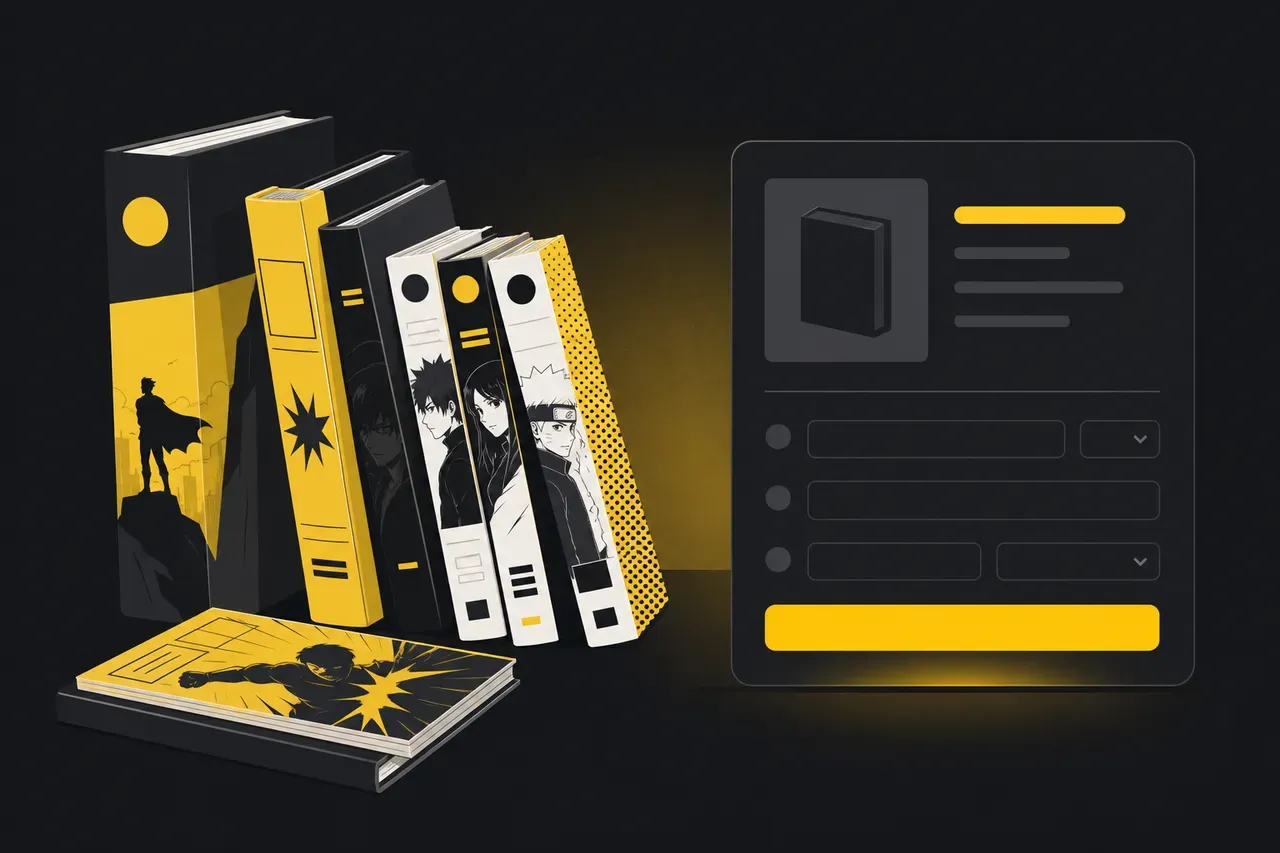
Yes, Vinted has a real category for books (novels, comics, manga, children's, school, magazines), and selling there costs a private seller 0% commission, as for the rest of the marketplace. The real question is not whether it is possible, but how to go about it: the unit price of a second-hand book stays low (often between €1 and €8), so profitability depends on volume and a bundle strategy, not on a single miracle sale. Add an item that is heavier than a T-shirt to ship, and you can see why selling books calls for a slightly different method from the one applied to a wardrobe.
This guide details what really sells, how to choose between selling individually and themed bundles, what to write in the description to reassure the buyer, and how to manage weight without letting shipping costs eat your margin.
Can you really sell books, comics and manga on Vinted?
Yes: Vinted groups books in a dedicated Entertainment category, with several distinct subcategories: fiction (novels), comics, manga and graphic novels, children and young adults, non-fiction, textbooks and educational resources, as well as magazines and colouring books (Vinted). It is therefore not a catch-all box: each type of book has its logical place, which helps a targeted buyer find you.
As for any item sold by a private individual on Vinted, no commission is taken on the price you set: it is the buyer who pays the Buyer Protection fee (a fixed part of around €0.70 plus 5% of the price), never you (Fripio). An ISBN is, however, requested for each listing: you scan the barcode on the back of the book, which automatically fills in a good part of the listing, or you enter it by hand if the book does not show one (Europarl).
Why sell your books on Vinted rather than elsewhere?
Three concrete advantages justify starting with Vinted rather than a buy-back site or a flea market: zero seller commission, a young audience that is very present on manga and comics, and a light item to ship once it is well prepared.
The absence of commission makes a big difference on items of low unit value: on a site that takes a share of the price, a €3 novel leaves almost nothing after fees. On Vinted, the price you display is the price you receive. The marketplace's audience also works in your favour on certain segments: the manga and comics market is still driven by a young readership, particularly fond of long series, sought-after first volumes and collector editions, an audience that naturally gathers on a marketplace like Vinted rather than on a classic second-hand book site. Finally, unlike a piece of furniture or a pair of shoes, a book is quick to pack, is not very vulnerable in transport and slips easily into Vinted Go parcel lockers, an economical shipping option well suited to this compact format (Picaillon).
Which books sell best on Vinted?
High-demand manga and comics, children's picture books by well-known authors, recent novels that are still sought after and practical guides sell most easily: old collectable magazines also find an audience, a more niche one but a real one.
In practice, a complete manga series or a first volume that has become hard to find in bookshops goes quickly, as does a collector edition. On the children's side, picture books by established authors sell steadily, driven by parents who look for a collection they already know rather than a discovery. Very recent novels that are still topical, cookery books and practical guides round out this trio well. At the other end, an old collectable magazine (a music or cult magazine from past decades, for example) does not sell in volume, but may surprise a specific collector ready to pay above the price of an ordinary book (Picaillon). Conversely, old school textbooks or very common novels with no particular demand remain the hardest segment to clear, whatever price is displayed.
Is it better to sell individually or in a bundle?
Keep individual sales for titles that have real individual value, and group the rest into themed bundles to sell faster and spread the shipping costs.
A sought-after volume, an out-of-print edition or a book in very good condition is better sold alone: putting it in a bundle dilutes its value and drowns it among less interesting titles. On the other hand, the bulk of your pile (novels read once, odd volumes of a series, magazines, children's books of the same age range) clears much faster when grouped by theme, author or collection (VintedCRM). The bundle has a double benefit: it makes up for a unit price too low to justify a separate shipment, and it shares the shipping costs across several items instead of one. The usual compromise is to accept a price per book slightly lower than for an individual sale, in exchange for a faster sale and a single parcel to prepare for several titles.
How do you describe a book to reassure the buyer?
A description that sells a second-hand book states the real condition of the book, its exact title, the author, the publisher and the year of publication: a book buyer is particularly sensitive to physical condition, much more than to the cut of a garment.
Be precise about the cover (scratches, bent corners, fading), the spine (yellowing, condition of the pages) and the presence of annotations or highlighting: a buyer who discovers an unmentioned defect on receipt opens a dispute, whereas the same information given in advance does not generally put off an interested buyer (VintedCRM). Also give the full title, the author and the edition in the text of the listing, not only in the dedicated field: this is what makes you appear in the search of a buyer who types a precise reference rather than a generic word like "novel" or "manga".
Which photos for a book listing that sells?
The photo that sells a book is that of its real cover, sharp, taken in decent light: never an advertising image or a photo found online, which is strictly forbidden on Vinted.
Show the whole cover, the spine (useful to judge the thickness and the condition of the paper along its length) and, if the book has a visible defect, a photo dedicated to that defect rather than an angle that avoids it. For a bundle, an overall photo in which each title is legible helps the buyer check at a glance what they are really buying, without having to ask for the list in a message.
How do you manage weight and shipping costs on bundles of books?
Weight is the real trap of second-hand books: unlike a garment, a book is heavy for its volume, and a bundle over 2 kg pushes up the shipping rate to the point of putting the buyer off (Picaillon).
The reflex is to factor this weight into your decision before publishing: either you adjust the price to absorb a more expensive shipment, or you limit the size of the bundle to stay within a shipping rate that does not scare the buyer away at the time of payment. For the shipment itself, a pickup point or a parcel locker remains the most economical option, and books (compact and not very fragile) suit it particularly well, unlike a bulky garment or a breakable object (Picaillon). Clearing three whole shelves can thus bring in a decent sum overall, without each book taken individually having great value: it is the volume effect that makes the result, not the rare item.
Should you sell your books somewhere other than Vinted?
Not necessarily as a replacement for Vinted, but a truly rare title (a sold-out collector edition, an item sought after internationally) may find a better price on a marketplace with a wider audience such as eBay, as a complement rather than instead of Vinted.
This is the principle of crosslisting: keep Vinted for most of your pile, general and free on the seller side, and keep high-value titles for a wider audience when it makes sense. Our guide on moving from Vinted to eBay details the fees and the method if you want to test this option on your most sought-after items. For the price, the same logic as for any item applies: start from a reasonable reference then adjust it based on completed sales rather than listings that are still online; the full method is detailed in our article on setting the right price and selling fast.
If you manage a volume of books that is starting to become difficult to publish one by one, StoFlow recognises the book category on the Vinted side and automatically adapts the attributes requested: no more need to fill in size, brand or colour, which make no sense for a novel; the fields that matter for this category (title, author, ISBN) are the ones Vinted really expects. The Free plan is more than enough to test publishing your first bundles with no commitment.
In the end, selling books on Vinted is not complicated, but it calls for different thinking from a classic wardrobe clear-out: rely on bundles for what sells cheaply, keep individual sales for titles that deserve it, be precise about condition and weight, and let volume (not the rare item) make the result.