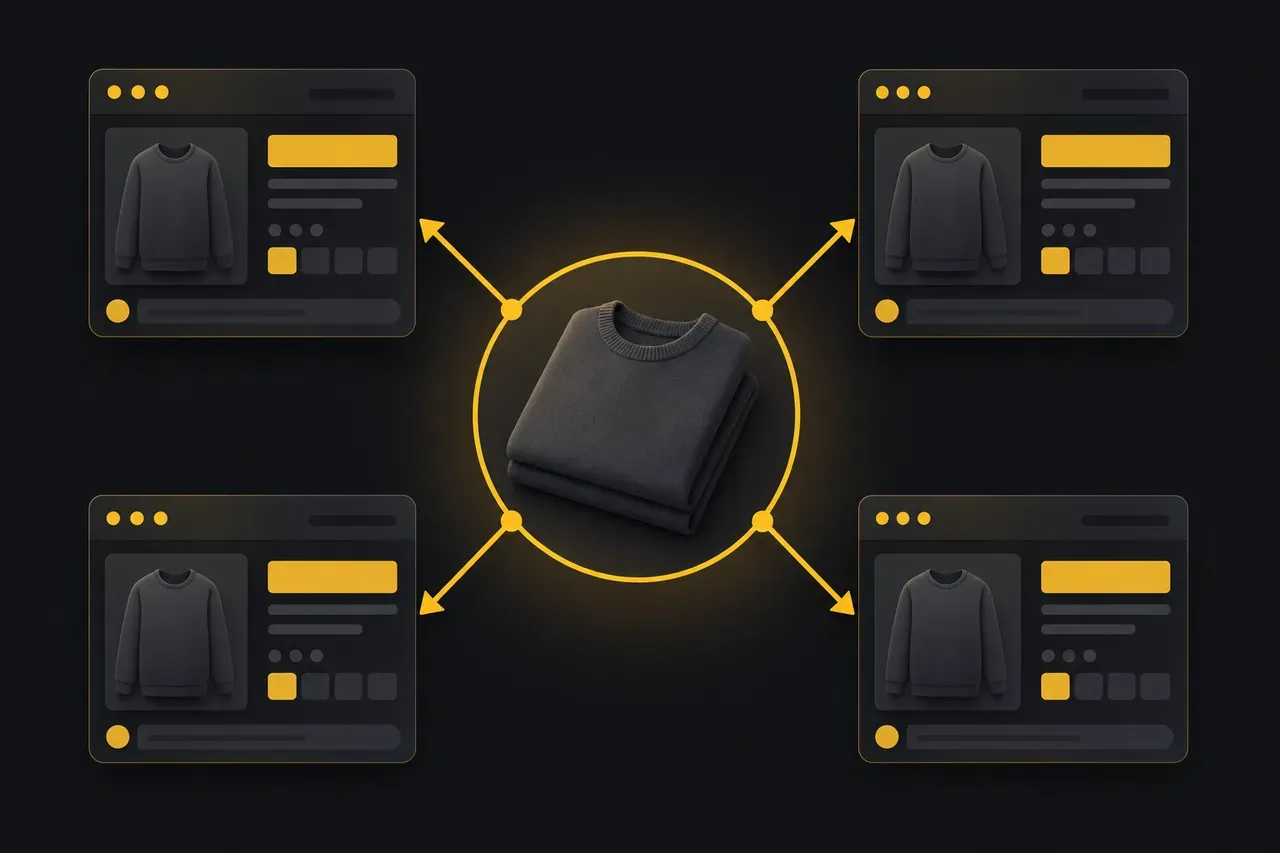
Crosslisting means publishing the same listing on several marketplaces at the same time (Vinted, eBay, Leboncoin, Vestiaire Collective, Etsy) instead of choosing a single one. Each product becomes visible to far more buyers, so it sells faster, and you do not retype the same description ten times. It is the number one growth lever for resellers moving from Sunday seller to business.
In this guide, we look at why it works, how to do it without drowning, and the one trap never to neglect: stock sync.
What exactly is crosslisting?
Crosslisting (or multi-listing) means listing the same product on several marketplaces simultaneously. A pair of trainers can thus be for sale on Vinted and eBay and Leboncoin at the same time.
The idea is simple: your stock does not change, but its exposure is multiplied. Where a Vinted listing alone reaches Vinted buyers, the same listing published on five marketplaces reaches five different audiences, each with its own habits and traffic peaks.
Why sell on several marketplaces at once?
Publishing everywhere increases your visibility, speeds up sales and makes you less dependent on the algorithm of a single marketplace. Three concrete reasons:
- More buyers, faster. Each marketplace has its own audience. Vinted dominates second-hand fashion in France: its gross merchandise volume reached about €10.8 billion in 2025, up almost 47% over one year (Vinted Financial Results 2025). But the electronics buyer stays on eBay, and local sales go through Leboncoin.
- You no longer depend on a single algorithm. If Vinted buries your listing, it still lives elsewhere. Do not put all your products in the same basket.
- The market is there. 66% of French people have already bought a second-hand product (iLigo Barometer 2026). Demand is not your problem: your visibility is.
Each marketplace has its own audience: what to sell where?
Crosslisting is not blind copy and paste: each marketplace has a profile. Distributing intelligently means selling at the right price to the right buyer.
- Vinted, the go-to for fashion and second-hand in France. 0% commission for the private seller (Buyer Protection is paid by the buyer). Ideal for everyday clothes.
- eBay: international and technical categories (sneakers, electronics, collectibles). No commission for a private individual whose address is in the EEA, on eBay.fr since 1 September 2026, with 150 free listings per month.
- Leboncoin: local, bulky items, in-person sales. 0 commission for the private seller.
- Vestiaire Collective, luxury and authenticated premium.
- Etsy: sought-after vintage and handmade, with an international audience (6.5% transaction fee).
- Opla, a general marketplace beyond fashion (home, sport, leisure), with no seller commission on a standard sale; available with StoFlow from the Pro plan.
A good crosslisting strategy plays on these differences: the same jacket can aim for the "everyday" price on Vinted and the "vintage piece" price on Etsy.
Does crosslisting also work specifically between Vinted and eBay?
Yes, and it is one of the most frequent moves among resellers who are growing. Vinted covers fashion and general second-hand in France; eBay reaches a more international and more technical audience (sneakers, electronics, collectors' items). Moving from one to the other, or using both, does not mean choosing: the same product page goes to both marketplaces, with the same stock sync work as for any other pair.
Adapting the same product page to each marketplace
Crosslisting does not mean pasting the same text and the same photos everywhere, identically. Three simple adjustments are enough for a single product page to really work on five marketplaces.
The title keeps the same structure everywhere: brand, model, colour, size, condition, then the feature that sets the piece apart (limited edition, rare cut, year). Example: "Levi's 501 vintage indigo blue W32 L30 very good condition selvedge" (the same title written for a French-speaking buyer would use the French keywords for indigo blue and very good condition). This structure works as well on eBay, where precise keywords matter for search, as on Vinted or Leboncoin, where the buyer must recognise the piece at a glance.
The photos are best taken once and for all in square format (1:1): it is the only ratio that displays correctly everywhere without recropping each time a new marketplace is added. One front view, one back view, one close-up of the material and one of the composition label, on a neutral background, and the shoot never has to be redone.
The description, finally, keeps its factual content (material, measurements, flaws) but benefits from changing tone: direct and relaxed on Vinted, structured in key points on eBay, practical and no-frills on Leboncoin, turned towards the story of the piece on Etsy when it has some history (vintage, archive, old piece). The same description pasted as it is on five marketplaces gets noticed, and not in a good way.
The real trap: stock sync
The number one risk of crosslisting is overselling: selling the same product twice because it was still online elsewhere. The result: an order to cancel, a disappointed buyer, and a reputation penalty on the marketplace.
The answer is called stock sync: as soon as a product sells somewhere, it must disappear from all the other marketplaces, immediately. Done by hand, it demands iron discipline and a lot of speed. This is precisely the work that a crosslisting tool automates for you.
With StoFlow, this sync is included from the Free plan, not reserved for paid plans: the feature that prevents a double sale is not meant to remain a premium selling point.
Vinted and Leboncoin: what does the rule against duplicate listings really change?
Leboncoin forbids publishing the same listing twice on its own site, not selling the same product elsewhere. The official help centre is clear: "Vous ne pouvez pas déposer une même annonce plusieurs fois sur le site" (you cannot publish the same listing several times on the site) and "Si vous avez besoin de vendre plusieurs fois le même produit, vous devez procéder aux ventes une par une, via une nouvelle annonce" (if you need to sell the same product several times, you must make the sales one by one, via a new listing). This rule targets duplicates inside Leboncoin (same title, same photos, republished to climb the results); it says nothing about selling the same product on Vinted, eBay or another marketplace in parallel.
On Vinted, removing a listing whose piece has sold elsewhere goes through two different tools: hide, which makes it invisible immediately (news feed, catalogue, closet) without losing its data, and delete, which erases it permanently but only once a Vinted transaction itself is finalised. When the piece goes to another marketplace, hide is what you must use, not delete, which stays blocked as long as Vinted itself has not recorded a sale.
Is crosslisting riskier during sales peaks?
Yes: more buyers look at each listing at the same time, so the window between a sale and its removal elsewhere becomes more dangerous, without the risk changing in nature. This is exactly what happens during Black Friday: the week-by-week, marketplace-by-marketplace detail is in our multi-marketplace Black Friday checklist.
Crosslisting by hand or with a tool?
By hand, crosslisting is possible but quickly unmanageable: you retype each listing marketplace by marketplace, you juggle photo formats, and you watch sales continuously to unpublish in time. It holds up on ten products, not on two hundred.
A crosslisting tool solves the three frictions at once: it publishes your product everywhere from a single product page, adapts the content to each marketplace's rules, and syncs the stock automatically on the first sale. That is exactly what StoFlow does, an all-in-one multi-marketplace tool: you create your product once, publish it on Vinted, eBay, Leboncoin, Vestiaire Collective and Etsy, and manage orders and messages from a single dashboard.
To sync stock between your marketplaces without ever selling the same piece twice, the method is detailed in avoiding double sales.
Where do you start?
Do not try to be everywhere from day one. The right progression:
- Choose two marketplaces that you already know: Vinted and Leboncoin are free for sellers and cover the French market.
- Get your flow running: clean photos, descriptions that convert, consistent prices between marketplaces.
- Add eBay and Vestiaire Collective to reach the international and premium audiences.
- Automate the sync as soon as the number of listings makes manual tracking impossible.
Crosslisting is not a trick, it is a change of scale. You go from one channel to a network, and it is that network that makes the difference between selling a few pieces a month and living off it.
Sources
- Leboncoin - Quelles règles doit respecter mon annonce ? (in French) - accessed 22 September 2026
- Vinted - Comment masquer, modifier ou supprimer des annonces (in French) - accessed 22 September 2026
- Opla - Conditions générales d'utilisation - accessed 22 September 2026