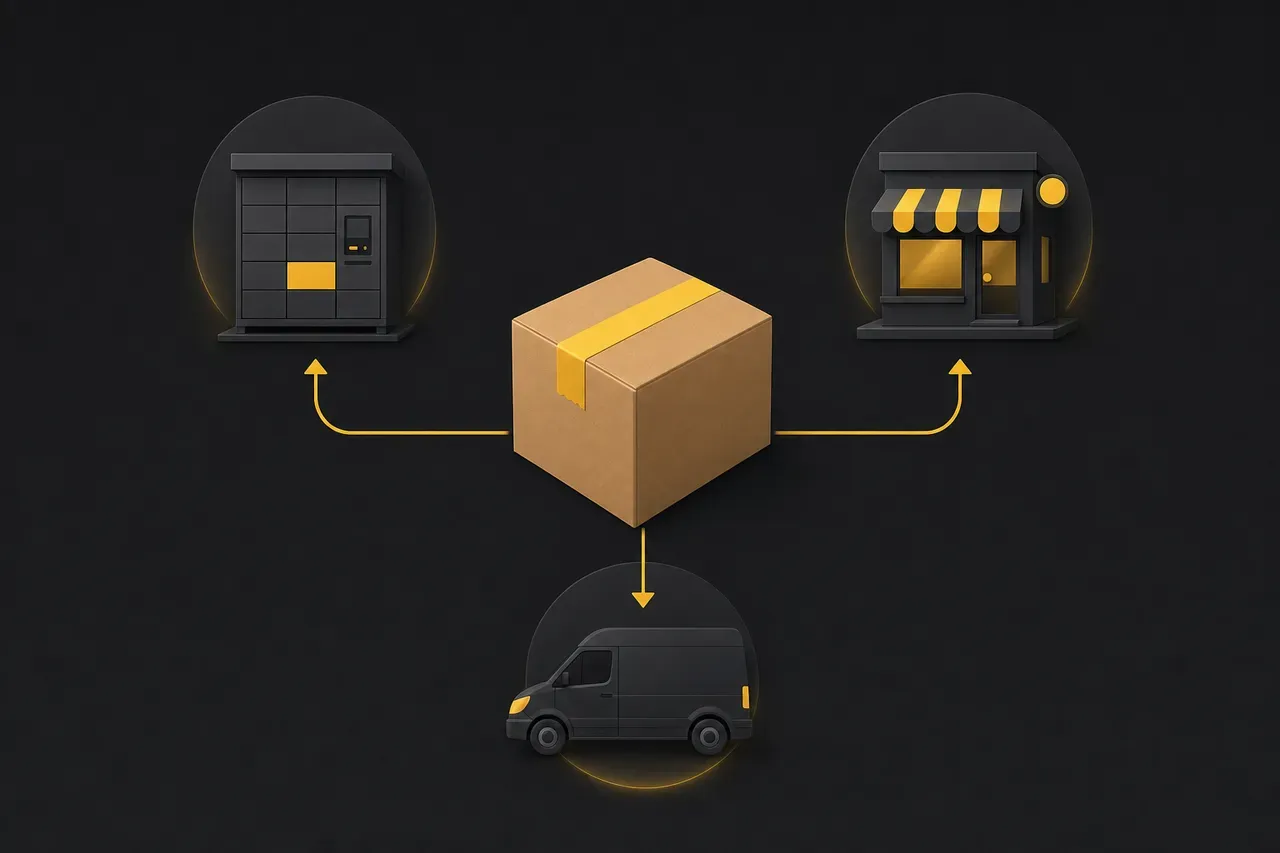
For a small, light parcel, Vinted Go in a locker (from about €2.50) and Mondial Relay at a pickup point (from about €2.69) are the cheapest options; Colissimo is structurally more expensive, but remains the only one to deliver to the letterbox without the buyer having to travel. The right choice depends on the actual weight of your product, its value, and the method the buyer selected at payment, not on a reflex adopted once and for all. This article details the figures compared, how to pack without paying for empty space, and above all how to prevent a simple shipping mishap from turning into a dispute that costs you the sale.
You have probably had that moment where you tick the default carrier without really looking at the displayed price, because you are in a hurry to confirm the shipment. On a one-off sale, the difference does not show. On fifty or a hundred parcels a month, it quickly adds up to tens of euros of margin lost, or gained.
Which carrier should you choose depending on the weight and value of your product?
Below 1 kg, Vinted Go and Mondial Relay are almost always the cheapest; between 1 and 5 kg, Mondial Relay remains competitive while Colissimo and Chronopost are mostly justified if the buyer wants home delivery or speed. For a valuable product, the price of shipping weighs less than tracking and insurance: a Chronopost tracked end to end is more reassuring on a €150 piece than a shipment at the lowest rate.
Here is a comparison of the orders of magnitude observed in 2026, compiled from several comparison sites specialising in second-hand shipping (Fripio, Vintify); the exact rates displayed in the Vinted app may vary slightly depending on current promotions:
| Carrier | Delivery option | Up to 500 g | 1 to 5 kg | Stated delivery time |
|---|---|---|---|---|
| Vinted Go | Automatic locker, 24/7 | ~€2.50 to €3.20 | not available beyond one size (rate by locker size, actual weight max 15 kg) | 3 to 6 working days |
| Mondial Relay | Pickup point | ~€2.69 to €3.90 | ~€4.90 to €6.90 | 3-5 days |
| Colissimo | Collection point | €6.89 | from €8.89 (1 kg) to €16.69 (5 kg) | 2 working days |
| Colissimo | Home | €7.59 | from €9.59 (1 kg) to €17.39 (5 kg) | 2 working days |
| Chronopost | Home/pickup point | ~€5.49 to €6.99 | ~€8.49 to €12.85 | 24-48 hours |
The Colissimo rates above are the official 2026 La Poste scale for mainland France; those for Vinted Go and Mondial Relay are not published by these carriers and remain orders of magnitude observed in the app.
The simple reflex: for everyday textiles of no great value, aim for a locker or pickup point first. For fragile, heavy or high-end items, accepting the Colissimo or Chronopost surcharge in exchange for tracking and more careful handling matters more than the two or three euros saved.
Vinted Go, Mondial Relay or Colissimo: what are the concrete differences?
Vinted Go works only through automatic lockers accessible 24/7, with no queue or opening hours; Mondial Relay goes through a partner shop with the shop's opening hours; Colissimo offers a post office, a Pickup collection point or home delivery, and it is the only one of the three that can also be dropped off directly from your own letterbox, without going through a drop-off point. On Vinted, the carriers integrated in France are Mondial Relay, Chronopost, Colissimo, Vinted Go and DHL Express (the latter mainly for international shipments), and the seller chooses which ones to activate in their settings.
The difference that matters most day to day is the size constraint. A Vinted Go locker imposes a strict maximum depth (38 x 30 x 18 cm for the largest size): beyond that, the parcel is refused at drop-off, even if it weighs much less than the 15 kg limit. A standard pickup point such as Mondial Relay tolerates more volume because a human receives the parcel behind the counter. Colissimo, finally, is the only option that avoids any trip to drop the parcel off, a real plus when the nearest pickup point is fifteen minutes away by car.
How do you pack a parcel properly so you do not pay for empty space?
The rate is calculated on the actual weight or the volumetric weight (whichever is higher), so packaging that is too big for the product makes you pay for air. For clothing, light and not very fragile by nature, a bubble mailer or an opaque plastic pouch with an adhesive flap is enough in the great majority of cases; there is no need to put a jumper in a box twice too big.
The reflex that avoids nasty surprises: gently compress the product to reduce volume without damaging it, close it with strong tape (no thin tape that cracks in transit), and check that nothing sticks out or makes a bump, which is often what makes an automatic locker's size check fail. For fragile items (jewellery, glass, ceramic), a rigid box with padding remains essential even if it costs a few cents more in shipping: the dispute over a broken product always costs more than a suitable box.
How do you print and stick the shipping label without going wrong?
The shipping label must be printed sharply, stuck flat without creases on the widest face of the parcel, and be the only one visible: remove or cover any old label from a previous shipment so the pickup point's scanner does not read the wrong barcode. A folded or partly peeled label can be enough to make the scan fail at drop-off, which delays your shipment by a whole day.
If you have no printer to hand, most pickup points and post offices can print the shipping label from the code received by text message or email; handy in a pinch, but to be avoided as a routine if you ship several parcels a week: the queue in the shop quickly becomes the real bottleneck, not the price of shipping.
How long does delivery take, and how do you track the parcel?
Vinted Go officially states 3 to 6 working days in its terms and conditions, Mondial Relay 3 to 5 working days, Colissimo 2 working days according to the La Poste scale, and Chronopost 24 to 48 hours; in every case, tracking is available directly in the order tab on Vinted, with no need for the carrier's website. These times remain indications: a public holiday, an activity peak (back to school, end-of-year festivities, Black Friday) or a poorly served rural area can easily extend them by 24 to 48 hours.
The right reflex on the seller side: drop off the parcel quickly after the sale (ideally within 2-3 days) rather than waiting, because a long drop-off delay is one of the most frequent grounds for complaint, well before any real shipping problem.
Locker, pickup point or home: who chooses, and what does it change for you?
It is the buyer who selects the carrier and the shipping method at the time of payment, from the options that you, the seller, have activated on your account, and once the product is sold, this choice can no longer be changed. In practice, your only room for manoeuvre is upstream: activating several shipping methods widens your potential audience, because a buyer who has no convenient locker or pickup point near them can simply move to the next listing if there is no option that suits them.
That means in practice: tick locker, pickup point AND a home option if you can, even if the home option costs the buyer a little more. It is not you who pays for it, it is simply one more option that can make the difference between a completed sale and an ignored listing. If a buyer has paid for a shipping method that you finally cannot honour, the only official route is to cancel the order and have the buyer order again: there is no button to change the shipping method along the way, and shipping with a label other than the one generated by Vinted deprives you of Vinted's compensation in case of a dispute.
How do you avoid a shipping dispute (lost, damaged or contested parcel)?
Proof of drop-off is your only real protection: keep the receipt from the pickup point or post office with the date and tracking number, and take a photo of the parcel just before dropping it off. Without this proof, you have almost no argument to counter a buyer who claims to have received nothing or to have received an item different from the one sold.
The simple reflex to adopt systematically: a photo of the closed parcel before drop-off, a screenshot of the tracking as soon as it appears, and keeping the receipt until the order is validated by the buyer, not just until delivery. The whole procedure, the claim deadlines and the possible remedies are detailed in our dedicated article: lost or damaged parcel dispute, the seller guide.
If the carrier confirms the loss or damage, Vinted compensates the seller according to a scale set by carrier, not a single amount: up to €500 with Vinted Go, €25 with Mondial Relay, €20 with Shop2Shop by Chronopost, €18 with Colissimo and €15 with DHL Express. It is one more reason to favour Vinted Go for a valuable piece that has not activated the verification service: the compensation ceiling there is far higher than with the other carriers.
Should you change carrier on every sale, or choose a routine?
Neither: keep a simple reflex (small light parcel → locker or pickup point, fragile or valuable product → carrier with reinforced tracking) rather than comparing prices on every listing, but stay attentive at the time of shipping since it is ultimately the buyer who decides the final method. What really costs time is not choosing the right carrier, it is managing shipping listing by listing as your catalogue grows.
If you still sell a handful of products a week, all this is handled by hand without trouble. If you start accumulating orders on several marketplaces at once, the real bottleneck becomes finding which order comes from where and which shipping label to print for which buyer. That is where centralising your sales makes a concrete difference: with StoFlow, you publish your product page once and it is published on Vinted, Leboncoin and the other marketplaces depending on your plan, with stock sync that automatically unpublishes everywhere as soon as a product sells somewhere, so you no longer chase a listing still online when it has already shipped elsewhere.
If your catalogue is growing fast, our article on managing hundreds of listings without spending your days on it takes up the organisation logic beyond the subject of shipping alone. And if it is rather the price of your products that makes you hesitate before even thinking about shipping, pricing to sell fast details the method, because a product well sold always starts before the choice of carrier.
Keep the essentials in mind: there is no universally "best" carrier on Vinted in 2026, there is a carrier suited to each parcel. A locker or pickup point for most of your everyday textiles, Colissimo or Chronopost when the value or fragility of the product justifies it, and in every case fitted packaging, a well-stuck shipping label, and proof of drop-off carefully kept until the end of the transaction. That is what protects your margin (and your seller reputation) far more than a carrier choice fixed once and for all.
Sources
- Quels sont les différents modes d'envoi sur Vinted ? (in French) - accessed 22 September 2026
- Comment gérer tes modes d'envoi ? (in French) - accessed 22 September 2026
- Quelle indemnisation pour le vendeur en cas d'envoi avec un bordereau d'envoi intégré ? (in French) - accessed 22 September 2026
- Conditions générales de Vinted Go pour les services de livraison (in French) - accessed 22 September 2026
- Tarifs Colissimo France (in French) - accessed 22 September 2026
- Envoyez votre Colissimo depuis votre boîte aux lettres (in French) - accessed 22 September 2026