No, you have nothing to declare if you are just selling your own second-hand belongings on Vinted; even though the platform passes your sales on to the tax authority as soon as you exceed €2,000 or 30 transactions a year (DAC7 obligation). It changes completely if you buy products with the aim of reselling them for more: that is a commercial activity, taxable from the first euro, to be declared under a status such as the micro-enterprise. The rest of this article draws the line precisely, threshold by threshold, with the 2026 figures.
Every spring, the same worry comes back among Vinted sellers: "am I going to get in trouble with the tax office?" Good news: for the overwhelming majority of users who clear out their wardrobe, the answer is no. This guide separates the occasional seller from the reseller, with the thresholds, the calendar and what it means in practice.
Are you selling your personal belongings, or buying to resell?
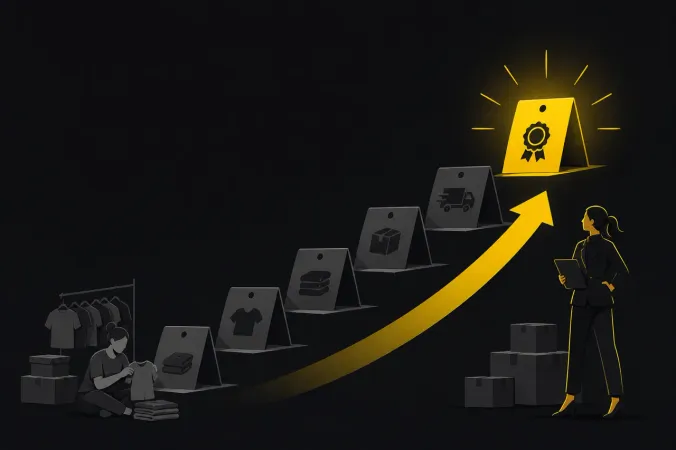
It all comes down to intention, not the number of listings. Selling clothes you have worn or objects you no longer use is personal asset management: not taxable. Buying stock, second-hand clothing by the kilo or lots to resell with a margin, on a recurring basis, is a commercial activity taxable like any other business.
The tax administration does not look at whether you have 5 or 500 listings online, but at the nature of the operation. The central criterion is repeated profit-making intent: do you buy for yourself (and then resell what you no longer use), or do you buy in order to resell for more? A wardrobe clear-out, even a generous one, remains a wardrobe clear-out. Regular sourcing from a professional second-hand clothes shop to supply a resale stock is already a business, even if you do not have a status yet.
It is this distinction, and not the amount passed on through DAC7, that determines whether you have to declare anything at all.
Taxable Vinted sale: in which box do you declare it if you are a private individual?
If you only sell your own belongings, the answer fits in one word: none. A Vinted sale between private individuals, covering used personal objects, is not reported in any box of your income tax return, whatever the number of transactions or the amount passed on by the platform under DAC7.
The box only exists for the other situation: that of the reseller who buys to resell at a profit, on a regular basis. That income is an industrial and commercial profit (BIC), to be reported in the boxes reserved for professionals on the supplementary form 2042 C PRO if you are a micro-enterprise. Between the two, there is no intermediate "occasional seller" box on the return: either your activity is not taxable and you declare nothing, or it is and it follows the micro-BIC regime (or the standard regime above the ceiling).
If a letter from the administration is already asking you to account for your sales, the procedure to follow (deadlines, reply, penalties incurred) is different from a simple annual declaration: our guide tax reassessment on Vinted and Leboncoin: what to do if the tax office contacts you? details the steps to follow and the exact deadlines.
What is DAC7, and why does Vinted pass on your sales to the tax authority?
DAC7 is a European directive that obliges platforms like Vinted to pass on each year to the French public finance directorate (DGFiP) the identity and total sales of any seller who exceeds 30 transactions OR €2,000 of revenue over the calendar year. It is an "or", not an "and": exceeding just one of the two thresholds is enough to trigger the transmission.
This obligation has been in force since 2023, with a first wave of transmission in 2024 on the previous year's sales. It does not only concern Vinted: all peer-to-peer selling platforms (Leboncoin, Vestiaire Collective, etc.) are subject to it as soon as they exceed these thresholds with a given seller. The report passed on contains your identity, your IBAN and the amount and number of your transactions, not the detail product by product.
The most misunderstood point (and the most reassuring) is that being flagged does not mean being taxed. The tax authority receives information; it presumes nothing about its nature. Whether you are a simple occasional seller or a professional reseller, the DAC7 threshold is the same: it is a data transmission threshold, not a taxation threshold. The two notions are often confused, including in some articles online, hence a spring worry that often has no reason to be there.
Selling your clothes and personal objects on Vinted: do you need to declare?
No, in the vast majority of cases. Reselling used personal belongings (clothes, shoes, books, everyday objects) is not taxable income, whether one-off or repeated, as long as it is not part of an organised commercial activity. The only notable exception: a single object sold for more than €5,000.
The French General Tax Code (CGI) places the sale of movable property for personal use outside the scope of income tax: logically, you do not "earn" anything by reselling a coat for less than you paid for it new. Two exceptions exist, rare for a typical Vinted seller:
- An ordinary movable asset sold for more than €5,000 (a collector's piece, a rare luxury bag) falls outside the exemption and moves into the regime for capital gains on movable property (article 150 UA of the CGI): the gain is taxed at 19%, plus 17.2% of social contributions, up to 36.2% in total, with an allowance of 5% per year of ownership beyond the 2nd (full exemption after 22 years).
- Precious metals are not covered by this €5,000 threshold: they fall under a flat-rate tax of 11% (plus 0.5% of CRDS, a social debt repayment levy) on the sale price, from the first euro.
- Jewellery, works of art, collectibles and antiques fall under the same flat-rate tax but at a rate of 6% (plus 0.5% of CRDS), and remain exempt below €5,000 of sale price, like any other movable asset.
For everything else (most of the wardrobe of an ordinary Vinted seller) there is nothing to declare. Still, keep a record of your purchases (receipts, history): in the event of an audit, the burden of proof that your activity is non-professional may fall on you.
Buying to resell on Vinted: when does it become taxable?
From the first euro of margin, if you buy with the aim of reselling at a profit: second-hand clothing by the kilo, de-tagged lots, sought-after sourcing, products bought specifically to be relisted. It is a commercial activity (BIC), to be declared under a status such as the micro-enterprise, regardless of the amount received or the number of sales.
The administration relies on a set of indicators to classify an activity as professional: recurrence of purchases intended for resale, volume of stock built up for that purpose, logistics organisation (bulk purchases, stock management), even commercial communication (shop name, professional-style description). None of these criteria is sufficient on its own, but their combination quickly sketches the profile of a reseller rather than a private individual clearing out a wardrobe.
If you recognise yourself in this profile (or if you intend to make a living from it eventually), the question of status deserves serious attention: which legal form, when to switch, which concrete obligations. All of this is detailed in the guide becoming a professional seller on Vinted.
Micro-BIC for resellers: ceiling, contributions, how does it work in practice?
The micro-BIC regime (sale of goods category) lets you declare your gross revenue without heavy accounting, up to €203,100 a year, a threshold raised for the 2026-2028 period (it was €188,700 over 2023-2025). You pay about 12.3% of social contributions on what you collect, and a flat-rate allowance of 71% applies automatically before income tax.
In practice, once registered as a micro-entrepreneur (via the INPI (French IP and business registry office) one-stop shop):
- You declare your collected revenue to URSSAF (the French social security contributions collector), each month or each quarter depending on your option, even if that amount is zero (or face a €60.10 penalty per missed declaration).
- Social contributions (12.3% for the sale of goods) are calculated directly on this gross amount, without having to justify actual expenses.
- For income tax, the administration applies a flat-rate allowance of 71% for professional expenses: you are taxed only on the remaining 29%, unless you opted for the flat-rate payment (paid at the same time as the contributions).
Durably crossing €203,100 of revenue moves you to a standard tax regime, with significantly heavier accounting and obligations: a threshold that concerns well-established resellers, rarely those starting out.
When and how do you declare your 2025 Vinted income (spring 2026)?
If you come under the micro-BIC regime, you declare your 2025 revenue during the spring 2026 tax campaign (April to June depending on your area), in the boxes reserved for professionals on the supplementary form 2042 C PRO, even if you opted for the flat-rate payment. If you only sell your personal belongings, you have nothing to enter anywhere.
The amounts to report appear on your annual tax statement, available in your online account from early February 2026. For a micro-entrepreneur selling goods, the box to fill in depends on your regime (flat-rate payment or not): the form always distinguishes the sale of goods from the provision of services, with different allowance rates. Two points of vigilance come up often:
- The URSSAF declaration (monthly or quarterly revenue) and the income tax return (2042 C PRO, once a year) are two separate procedures, one does not exempt you from the other.
- The amount to declare is the gross revenue collected, not your margin or your real profit. It is the flat-rate allowance that acts as the expense deduction, you deduct nothing yourself.
How do you keep a clear view of your profitability all year?
Whether you are on the private individual side or the declared reseller side, the real headache is rarely the box to tick: it is knowing, in real time, how much you have sold, on which platform, and at what margin. Discovering in April that you have to dig out twelve months of Vinted history to reconstruct a revenue figure is the scenario that turns a simple declaration into a chore.
This is where a centralised dashboard changes the game. StoFlow publishes your listings on Vinted, eBay, Leboncoin, Vestiaire Collective and Etsy simultaneously, and centralises orders and messages in a single dashboard: with profitability statistics that show, marketplace by marketplace, what you have really sold and earned. Useful to anticipate whether you are approaching a DAC7 threshold or the micro-BIC ceiling, but above all to run your activity instead of putting up with it at the end of the year.
If you are only starting to sell on several platforms, the crosslisting guide explains how to multiply your visibility without multiplying your workload, and StoFlow offers a Free plan up to 100 products, more than enough to test the tracking before moving to a paid plan if your activity grows.
This article explains the general principle and the thresholds in force, it is not personalised tax advice: your exact situation (nature of sales, purchase history, amounts involved) may merit the opinion of a tax law professional, or of the administration itself in case of persistent doubt.
Remember the essentials: selling your wardrobe is not declared, buying to resell is declared from the first euro. Between the two, DAC7 only passes on information: it is the nature of your activity, not the amount passed on, that decides what you owe the tax authority.
Sources
- Comment déclarer mes revenus issus de l'économie collaborative (DAC7, seuils et exceptions bijoux/objets d'art/biens de plus de 5 000 €) - accessed 22 September 2026
- BOFiP - Cession de biens meubles : exonération sous 5 000 €, régime des plus-values au-delà (article 150 UA du CGI) - accessed 22 September 2026
- BOFiP - Taxe forfaitaire sur les objets précieux : taux de 11 % (métaux précieux) et 6 % (bijoux, objets d'art, de collection ou d'antiquité) - accessed 22 September 2026
- Micro-entrepreneur : quand déclarer son chiffre d'affaires ? (pénalité de 60,1 € par déclaration manquante, à jour au 1er janvier 2026) - accessed 23 September 2026