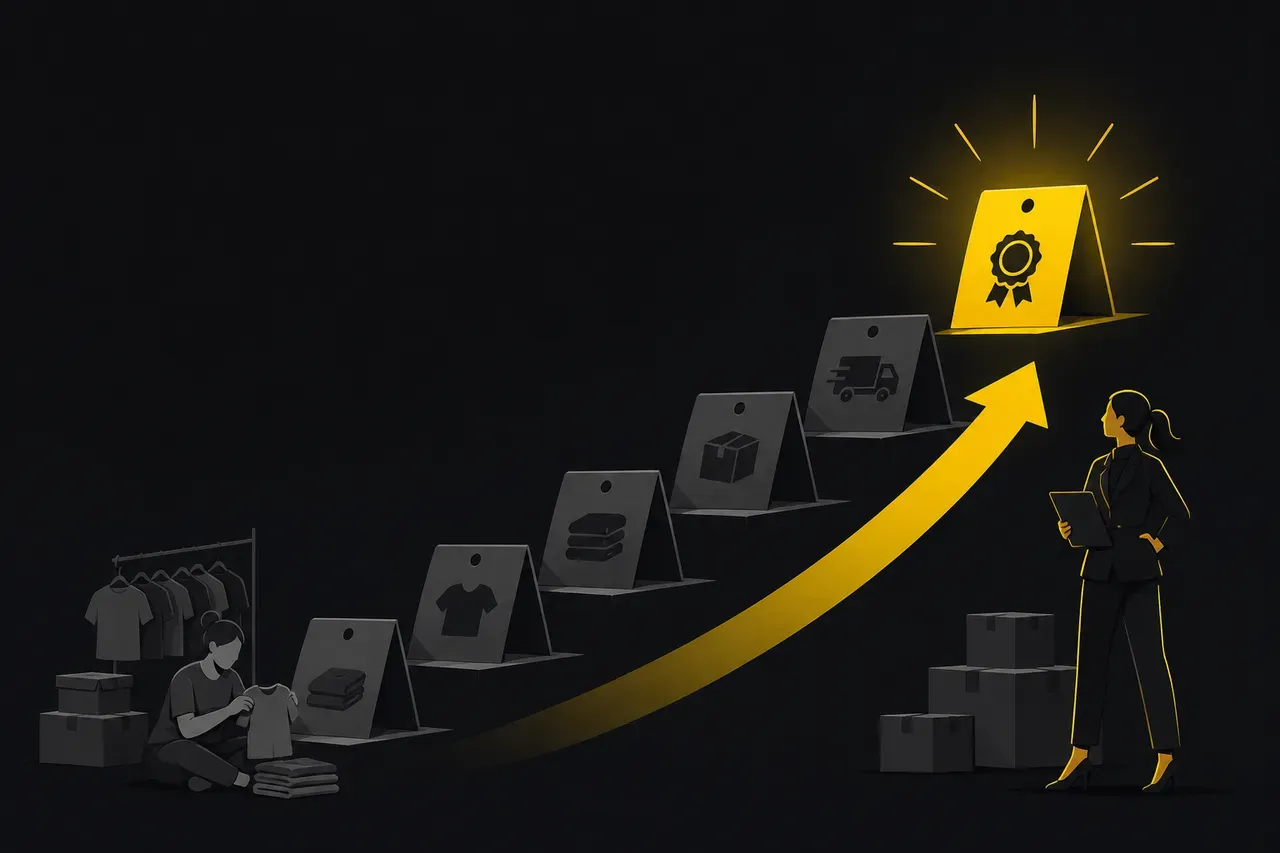
No, activating the "Pro" badge in the Vinted app does not make you a professional seller in the eyes of the law, and the reverse is also true: you can be a professional reseller for tax purposes without ever having ticked that box. The badge is a platform feature, reserved for those who already have a SIRET (the French business registration number). The real legal status (auto-entrepreneur or micro-entreprise (French sole-trader regime), the French simplified self-employed regime) is created separately, free of charge, on the French business one-stop shop (guichet unique, run by the INPI), and becomes mandatory as soon as you buy to resell with a profit objective. This guide distinguishes the two and explains when, why and how to take the step in 2026.
Many sellers discover the Pro badge on their Vinted profile and wonder whether activating it puts them in order with the tax authorities, or, conversely, whether they can carry on buying and reselling without ever touching it. Both questions start from the same confusion: between a product feature and a legal obligation. They have nothing to do with each other.
What exactly is the Vinted "Pro" badge, and why does it not replace a status?
The Pro badge is activated on the dedicated portal pro.vinted.fr and gives access to unlimited sales, a trust badge visible on your profile and wider visibility across Europe. It is a commercial tool of the marketplace, not an administrative procedure: Vinted only displays a status that you must have created elsewhere.
The clearest proof of this distinction: to activate the Vinted Pro account, the marketplace asks you to provide a SIREN/SIRET number attached to an existing legal status (micro-entreprise, sole proprietorship, SASU or EURL, the French single-shareholder company forms). Without this number, registration on the pro portal is technically impossible. In other words, the badge is not the first step of your journey as a reseller: it is the last, the one that comes after the creation of your status, not before.
Conversely, the tax authorities never look at this badge. They consider an activity professional as soon as it is regular, organised and profit-oriented, whether you ticked the box on Vinted or not. A seller who buys and resells at a profit on a standard personal account, without the Pro badge, remains subject to the same tax obligations as a seller displaying the badge. The badge protects you from nothing and exempts you from nothing.
Selling your personal belongings on Vinted: do you need to create a status?
No. Selling clothes you have worn or objects you no longer use remains management of personal assets, even if you do it often and even if you exceed the DAC7 (the EU directive on tax reporting by platforms) reporting thresholds (30 transactions or €2,000 per year). No registration is needed for this type of sale, whatever your volume of listings.
This point, often a source of anxiety at tax time, deserves to be clearly distinguished from the question of professional status: DAC7 is a threshold for transmitting data to the tax authorities, not a threshold for taxation nor a trigger for a status obligation. The full detail (what Vinted transmits, what remains non-taxable, the exception of unique objects sold for more than €5,000) is covered in our article Vinted taxes 2026: do you need to declare your sales to the tax authorities. Here, simply remember that emptying a wardrobe, however generously, obliges you to nothing on the status side.
Buying and reselling on Vinted: when does the status become mandatory?
As soon as you buy products (second-hand clothes by the kilo, lots, clearance stock, sought-after sourcing) with the aim of reselling them at a margin, on a recurring basis. It is a commercial activity in the legal sense, and it applies from the first euro of margin, regardless of the amount received or the number of sales made.
The tax authorities rely on a bundle of indicators to qualify this shift: recurring purchases intended for resale, building up a stock for that purpose, dedicated logistics organisation. No single criterion is decisive, but their combination quickly draws the profile of a reseller rather than a private individual. If you recognise yourself in this profile (or if you intend to make a living from it eventually), the question is no longer whether you must create a status, but when to do it without dragging your feet, to avoid a gap between your real activity and your declared situation.
Micro-entreprise reseller: which regime, which ceiling, which contributions in 2026?
For the overwhelming majority of Vinted resellers, the suitable regime is the micro-entreprise, category BIC sale of goods (BIC: industrial and commercial profits). The annual revenue ceiling is €203,100 for the 2026-2028 period (versus €188,700 over 2023-2025), and social contributions represent about 12.3% of your gross revenue received.
For income tax, a flat-rate allowance of 71% applies automatically to this revenue to cover your professional costs, with no need to justify actual expenses. In practice, on €10,000 of revenue, you are taxed only on the remaining €2,900. One point of vigilance: at the start, the ACRE (business creation aid) halves your contributions for the first four quarters, but this reduction decreases on 1 July 2026, when the reduced rate moves from 50% to 75% of the normal rate. If you are hesitating about getting started, this calendar is one more argument not to wait too long.
On VAT, you invoice without VAT as long as you stay below the VAT exemption threshold (franchise en base) set at €85,000 (base threshold) and €93,500 (increased threshold) for the sale of goods in 2026: amounts unchanged since 2025, the reform that was supposed to lower them having been definitively abandoned by the French law of 3 November 2025. For a reseller who is starting out, this threshold is rarely an immediate constraint.
How do you set up your micro-entreprise to sell on Vinted, step by step?
The procedure is free and done entirely online, on the French business one-stop shop (guichet unique, run by the INPI; formalites.entreprises.gouv.fr), the only entry point for this type of creation since 2023.
- You fill in the creation form by choosing the APE code 4779Z (retail sale of second-hand goods), the most suitable for resale activity.
- The one-stop shop automatically transmits your file to the URSSAF (the social security contributions body), the DGFiP (the French tax authority), Insee (the national statistics institute) and the other partner bodies; you have no separate procedure to do on your side.
- Your SIRET number arrives within 2 to 4 weeks, free of charge.
- Once you have this SIRET, you can if you wish activate the Pro badge on pro.vinted.fr: the product step comes after the administrative step, never before.
Beware of third-party sites that charge for this registration: creation on the official one-stop shop is and remains free.
How do you actually open a Vinted Pro account, once you have your SIRET?
The pro.vinted.fr portal is open to sole traders, non-profit organisations and companies registered in France as well as in several other European countries (Italy, Spain, Portugal, Belgium, Luxembourg, the Netherlands). Vinted asks for your SIRET number (your business identification number, made up of 14 digits), your VAT number if you have one, the details of your legal representative and your business address.
Registration takes place in three stages: you enter this business information, you complete your profile, then you submit professional identity verification documents (KYC/KYB, "Know Your Customer / Know Your Business"), the standard procedure of any payment platform to confirm who you are. If you already had a standard Vinted account with sales in progress, you also accept the transfer of your existing proceeds to a new Pro wallet: Vinted states that transferred proceeds appear in your bank account within 5 working days, and that any problem is dealt with within 2 working days.
As long as this file is not complete, registration on the Pro portal stays blocked: it is the confirmation, on the marketplace side, of what the law already says, namely that the SIRET always comes before the badge.
Does Vinted charge a commission or specific fees to Pro accounts?
No, at the date this article was consulted. The official page vinted.fr/pro states it explicitly: Vinted Pro is presented as entirely free, and listing for sale as completely free, with no mention of a commission or a fixed fee specific to the badge. If this pricing policy changed, it would be announced on that same page; check it before moving a large volume of listings.
A concrete difference does exist on discounts, however: Vinted states, in its help page dedicated to the Pro seller, that bundle discounts are not allowed for a Pro account, whereas a standard private account can offer them to its buyers. Buyers still keep the advantage of reduced shipping costs when they group several of your products in the same order.
Once the status is created, what changes concretely day to day?
Professional seller status brings real obligations, distinct from simply displaying the badge. Vinted reminds sellers that every professional must declare themselves as a "Pro seller" on the marketplace, on pain of penalties that vary depending on the country of registration. Once declared, you must in particular:
- Publish a detailed description of each product, its price including VAT, your professional identity and your contact details, as well as your payment and delivery conditions.
- Grant your buyers a right of withdrawal of 14 calendar days from the day after delivery, and refund them in full within 14 days of the date on which you are informed of their decision to withdraw, unless you defer this refund until you have recovered the product or received proof of its dispatch (whichever of the two comes first): there is no exception for second-hand goods.
- Cover each sale with the legal guarantee of conformity, valid for 2 years after delivery, and the guarantee against hidden defects, valid for 2 years from the discovery of the defect (French Civil Code, art. 1648), a duration distinct from the previous one.
- Display legal notices and terms of sale on your profile, and issue an invoice for each sale.
You must also declare your revenue received to the URSSAF every month or every quarter, even at zero. These obligations, not the badge, are what really define what "being pro" means in the eyes of the law. Staying on a standard personal account while running an organised commercial activity exposes you to a risk of tax audit, with a possible retroactive reassessment of sales already made (the detail of this procedure, its deadlines and the possible remedies are covered in our article Vinted and Leboncoin tax reassessment: what to do), and, on the marketplace side, to an account suspension if Vinted detects the inconsistency between the volume of activity and the absence of a declared status.
How do you manage your activity once you have gone pro?
Once the status is created, the real challenge changes nature: it is no longer a question of whether you must declare, but of correctly tracking your revenue, your margins and your sales as you go, rather than reconstructing twelve months of history the day before a URSSAF deadline. This is particularly true when you start publishing on several marketplaces at once to speed up your sales, a strategy detailed in our crosslisting guide.
That is where a tool like StoFlow makes full sense: it centralises your Vinted, eBay, Leboncoin, Vestiaire Collective and Etsy listings in a single dashboard, with profitability statistics that show what you have really sold and earned, marketplace by marketplace; a real time saver when your volume of listings grows to the point of becoming hard to track by hand, a threshold covered in more detail in our article on managing hundreds of listings. StoFlow offers a Free plan up to 100 active products, more than enough to test tracking before moving to a paid plan if your activity grows.
Keep the essentials in mind: the Vinted Pro badge is an app setting, not a status. It is your intention (buying to resell at a profit, on a regular basis) that triggers the obligation to create a micro-entreprise, free of charge and within a few weeks on the French business one-stop shop (guichet unique). Once this step is done, activating the badge on Vinted or not becomes a commercial choice, no longer a tax question.
Sources
- Vinted Pro (in French) - accessed 22 September 2026
- Guide Vinted Pro (in French) - accessed 22 September 2026
- Comment utiliser Vinted en tant que vendeur Pro (in French) - accessed 22 September 2026
- S'inscrire en tant que vendeur Pro - accessed 23 September 2026
- Code de la consommation, art. L221-18 - délai de rétractation, Légifrance (in French) - accessed 23 September 2026
- Code de la consommation, art. L221-24 - remboursement après rétractation, Légifrance (in French) - accessed 23 September 2026
- Code civil, art. 1648 - vices rédhibitoires, Légifrance (in French) - accessed 23 September 2026